Home About Projects (1,725 jobs) Our clients Services Soil Investigation & Testing Pile Testing Topographic Survey Geotechnical Instrumentation Structural Testing (NDT) Environmental Site Assessment Geotechnical Design Civil & Structural Design Articles Careers Contact · Request a quote
Service overview

Environmental Site Assessment Services at a Glance

Environmental Site Assessment is the collection of real data from a site: groundwater level and quality, aquifer properties, soil contamination and groundwater flow direction. It supports EIA reports, operating license applications and risk assessment before buying or selling land. SPN performs all fieldwork in-house, from drilling and installing wells and aquifer testing to sampling, while chemical analysis and EIA reports are coordinated with licensed partners.

Scope

Scope covered

  • Monitoring Well installation to ASTM D5092 · Water levels · Data Logger · Decommissioning
  • Slug / Pumping Tests and Resistivity surveys for aquifers
  • Test Pit · Hand Auger · Low-flow Sampling and contamination maps
  • Baseline and Monitoring Programs to support EIA
When to use

When it is needed

  • Factories or projects with EIA monitoring conditions
  • Supporting operating license applications
  • Risk assessment before buying or selling land
  • Locating aquifers and groundwater flow direction
Deliverables

What you receive

  • Well Completion Log and wellhead elevations
  • Water level tables and graphs, Piezometric Map and aquifer test results
  • Lab results from an accredited partner laboratory
  • Engineer-signed report, ready to pass to the EIA consultant

SPNDone in-house by the SPN teamPartnerLicensed laboratory / consultantSPN + PartnerJoint work, coordinated by SPN

Monitoring Well & Groundwater Level

What is a Monitoring Well, and how are wells installed and groundwater levels measured?

A Monitoring Well (observation well) is drilled and installed to ASTM D5092 to measure groundwater levels and collect groundwater samples. SPN installs wells that remain usable throughout the project, takes periodic readings or records automatically with a Data Logger, and decommissions wells that are no longer used.

Monitoring Well InstallationSPN

Drilling and installing groundwater observation wells

PVC casing with a Slotted Screen in the target aquifer, washed-sand Filter Pack, Bentonite Seal against cross-layer contamination, and a lockable Well Cap. Well Development before the first sampling, with a Well Completion Log

ASTM D5092Well Development
How are observation wells installed? →
Groundwater Level MeasurementSPN

Periodic groundwater level readings

Measured with a Water Level Meter to ±1 cm accuracy, referenced to one set of wellhead elevations for all wells. Tables and trend graphs by season or at the intervals set by EIA conditions

Water Level MeterTrend graphs
How groundwater affects foundations →
Groundwater Level Data LoggerSPN

Data Logger for continuous water level recording

A Pressure Transducer installed in the well records water levels automatically at set intervals, with Barometric Compensation. It captures the effects of rain, tides and pumping that manual readings miss

Pressure TransducerBarometric Compensation
Piezometer / Observation Well installation →
Well DecommissioningSPN

Sealing and decommissioning disused wells

Decommissioning of Monitoring Wells or boreholes at the end of their service life by grouting the full depth with Bentonite or Cement Grout, cutting off the wellhead and restoring the ground, so old wells do not become shortcuts for contaminants into the aquifer. A decommissioning record is provided

ASTM D5299Grout Seal
Hydrogeology

How are aquifers and groundwater flow direction determined?

Electrical resistivity surveys locate aquifers, permeability tests measure aquifer properties, and flow direction is analyzed from observation wells. The data is used in EIA reports, dewatering work and well placement.

Slug Test / Pumping TestSPN

Aquifer permeability testing

A Slug Test can be done quickly in a Monitoring Well without pumping large volumes of water. A Pumping Test pumps continuously while levels are measured in surrounding observation wells. Both give Hydraulic Conductivity (K) and Transmissivity (T), used to assess dewatering and impacts on adjacent areas

K / T valuesSlug TestPumping Test
Used in Dewatering design →
Resistivity Survey (VES / ERT)SPN

Electrical resistivity survey for aquifers

Electric current is passed into the ground through a line of surface electrodes to produce a resistivity cross-section. It is used to estimate aquifer depth and thickness, saltwater zones, or anomalies that may relate to contamination, before choosing confirmation boring locations

ASTM D6431VES / ERT
Groundwater Flow DirectionSPN

Groundwater flow direction analysis

Water levels from at least 3 wells referenced to the same datum are used to produce a Piezometric Map showing flow direction and gradient, identifying Upgradient and Downgradient wells for the contamination monitoring plan

Piezometric Map≥ 3 wells
Samut Prakan case study →
Soil & Groundwater Sampling

How are soil and groundwater sampled for contamination testing?

SPN collects soil samples by Test Pit / Hand Auger and groundwater by Low-flow sampling, takes field readings in-house, then submits samples to an accredited partner laboratory with a Chain of Custody.

Soil SamplingSPN

Test Pit / Hand Auger soil sampling

Samples are taken from Test Pits (2–4 m deep) and Hand Auger holes (1–3 m deep) on a grid plan or at risk points such as chemical storage tanks and material stockpiles, packed in Clean Containers and kept chilled in transit

Test PitHand AugerChain of Custody
Checklist before buying factory land →
Groundwater SamplingSPN

Low-flow groundwater sampling

Low-rate pumping until field readings stabilize before sampling, reducing sediment and loss of volatiles. pH, EC, DO, ORP and Turbidity are measured in the field; containers are chosen by parameter and delivered to the laboratory within the required holding time

ASTM D6771pH · EC · DO · ORP
Laboratory AnalysisPartner

Laboratory contaminant analysis

Heavy metals (As, Cd, Cr, Pb, Hg) by ICP-MS, VOCs by GC-MS, TPH, general water quality and microbiology, performed by an accredited partner laboratory. SPN submits the samples and follows up on the results

ICP-MSGC-MSTPH
Contamination Boundary MappingSPN + Partner

Contamination boundary mapping

Sampling locations, analysis results and groundwater flow direction are combined on one map, showing points above the criteria and the approximate extent. Used to plan the next sampling round or support a risk assessment

Site PlanHotspot Map
Risk Assessment & Remediation PlanPartner

Risk assessment and remediation planning

Health and environmental risk assessment and site remediation planning are done by a specialist partner. SPN hands over all field data and can carry out the fieldwork in the remediation phase

Risk AssessmentRemediation
EIA Support & Monitoring Program

What field data does a project requiring an EIA need?

Pre-project baseline data, a plan of monitoring points and rounds, and accurate field reports that the EIA consultant and authorities can use right away (SPN does the fieldwork and does not prepare the EIA report itself).

Baseline Environmental SurveySPN

Pre-project baseline survey

Wells are installed and groundwater level and quality data, plus soil samples, are collected before construction or operation, serving as the baseline for later monitoring reports

BaselineEIA
Environmental Monitoring ProgramSPN + Partner

Planning monitoring points and rounds

Well locations, parameters and measurement schedules are designed to match the measures in the EIA report, together with the project's environmental consultant, so data from every round is comparable

EIA MonitoringSampling Plan
Field Report & EIA ReportSPN + Partner

Field reports and EIA reports

SPN delivers engineer-signed field reports (Well Log, water level tables, sampling records, Lab results). The EIA report itself is prepared by a consulting firm licensed by ONEP, with SPN coordinating complete data

Signed by COE-licensed engineerONEP consultant
EIA conditions or a suspected contaminated site? Let an engineer review it first

Send the site plan, objectives and parameter list (if any) via LINE — SPN helps place wells, set the number of sampling points and provide one quotation including Lab work within 24 hours.

Environmental Fieldwork Projects

Click a photo to enlarge
Test Pit — soil sampling
Test Pit
Test Pit — soil sampling
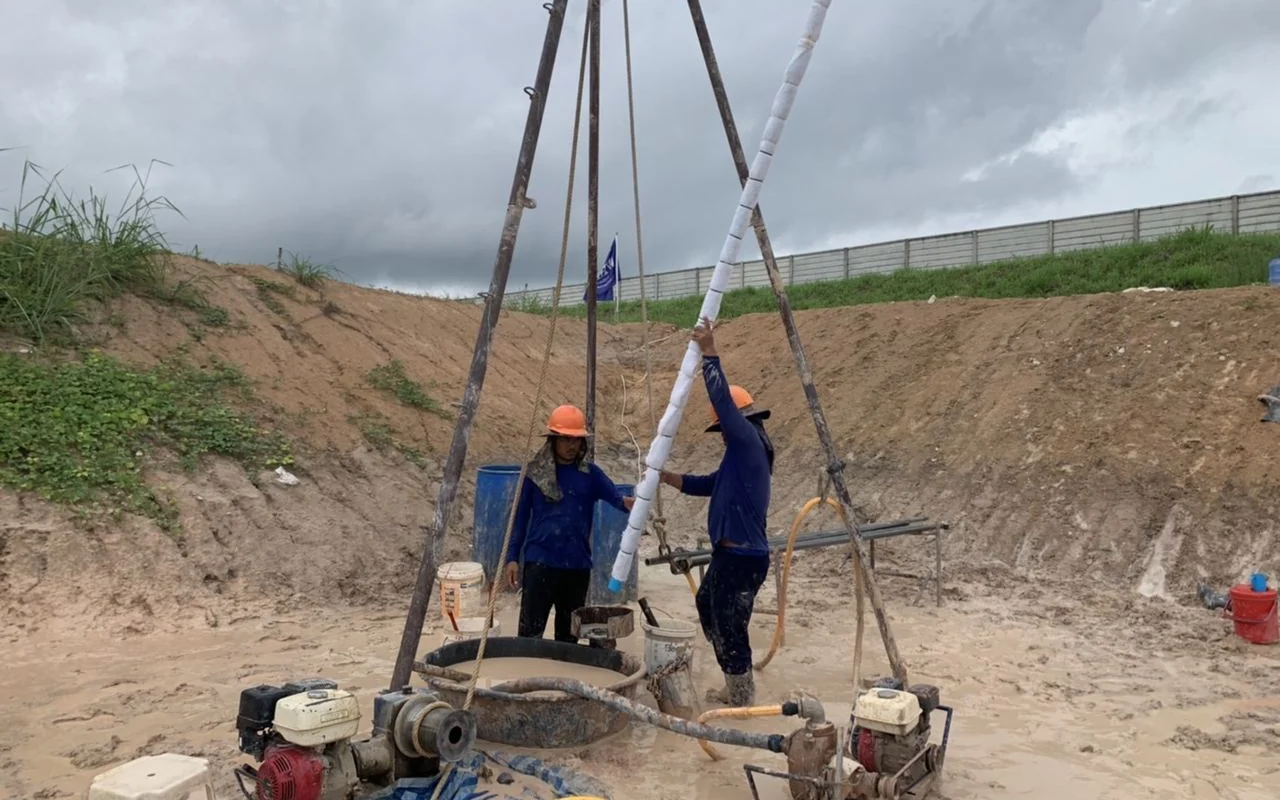
Drilling and installing a Monitoring Well
OW — Install
Drilling and installing a Monitoring Well
Monitoring Well Installation — diagram
OW — Diagram
Monitoring Well Installation — diagram
Monitoring Well No.3 completed
OW — Done
Monitoring Well No.3 completed
Hand Auger — soil sampling near a building
Hand Auger
Hand Auger — soil sampling near a building
Water Analysis — water quality analysis
Water Analysis
Laboratory water quality analysis

What environmental fieldwork has SPN carried out?

Real examples from case studies and the project photos above

Monitoring Well + Piezometer · Samut Prakan

Monthly groundwater level monitoring in soft clay

A Monitoring Well installed together with a Standpipe Piezometer with its tip at 8 m depth, read monthly to support the project's monitoring and as a groundwater level reference.

  • ASTM D5092
  • Monthly readings
Read the full case study →
Test Pit · Hand Auger

Soil sampling on site and close to buildings

Test Pits were opened and a Hand Auger used to collect soil samples where drill rigs cannot reach, such as areas next to buildings, before submission to a partner laboratory for analysis.

  • Test Pit
  • Hand Auger
Monitoring Well No.3

Observation well drilled and installed, ready for use

An observation well was drilled and installed, with a Well Completion Log recording soil layers, Screen length and wellhead elevation, then water samples were collected for laboratory analysis.

  • Well Completion Log
  • Sent to partner lab
Work process

What is the process for environmental work with SPN?

One contact, one quotation — SPN does the fieldwork and coordinates the Lab / EIA consultant through to the report

  1. Send site information and objectives

    Site plan or coordinates, objectives (EIA conditions, land purchase or sale, or after a spill) and the required parameter list (if any)

  2. Plan boring points and parameters

    Well locations and depths, sampling points and the analysis list are set with the partner Lab, with a quotation within 24 hours.

  3. Site preparation

    Check underground pipes and cables before drilling, arrange site access and prepare sample containers by parameter — see the site preparation checklist

  4. Fieldwork

    Drilling and installing wells, well development, water level readings, aquifer testing and soil/groundwater sampling with field measurements, typically 1–3 days depending on the number of points

  5. Laboratory submission

    Chilled samples with a Chain of Custody are delivered to an accredited partner Lab; analysis takes about 5–14 working days depending on the parameters

  6. Reporting and data handover

    Engineer-signed field report with Lab results and maps, passed to the EIA consultant or submitted to the authorities — about 2–4 weeks in total

Information and deliverables

What to prepare, and what you receive

Actual deliverables depend on the scope of work; the engineer lists them in the quotation

Information to prepare

  • Site plan and locationsFactory/land plan, locations of chemical storage tanks, treatment ponds or suspected points — no map yet? SPN can survey it
  • Objectives and conditionsMeasures in the EIA report, license conditions, or buyer/tenant requirements
  • Parameter listHeavy metals, VOCs, TPH or general water quality — if unclear, SPN can propose one with the Lab
  • Site historyPast activities, substances used or stored, and existing wells or boreholes on site

What you receive from SPN

  • Well Completion LogWell installation details, soil layers, Screen length and wellhead elevation
  • Water level tables and graphsPeriodic readings and Data Logger data (if installed)
  • Piezometric MapGroundwater flow direction and gradient
  • Aquifer test resultsK / T values from Slug or Pumping Tests and Resistivity sections
  • Sampling recordsField pH, EC, DO, ORP readings and Chain of Custody
  • Lab resultsFrom an accredited partner laboratory
  • Sampling and results mapPoints above the criteria and the approximate extent
  • Engineer-signed reportWith site photos, ready to pass to the EIA consultant

Environmental Site Assessment Services — SPN Soil Engineering

SPN Soil Engineering provides environmental fieldwork, including Monitoring Well installation, soil and groundwater sampling and groundwater level measurement. SPN does not have its own chemical analysis laboratory and does not prepare EIA reports — we coordinate the handover of samples and data to accredited partner laboratories and licensed EIA consulting firms to complete the service end to end.

SPN does the fieldwork — Partners take it from there
Laboratory analysis of samples and EIA report preparation are carried out by accredited, properly licensed partner firms — clients receive a complete service under one quotation, with SPN coordinating everything.
Technical details: work SPN does in-house and work by Partners

1. Fieldwork performed directly by SPN

SPN's engineers and technicians go on site for every job, certified by a licensed engineer

  • Monitoring Well Installation (ASTM D5092) — drilling and installing Monitoring Wells to ASTM D5092, with Slotted PVC Screen, washed-sand Filter Pack, Bentonite Seal against cross-layer contamination and a dust-proof Well Cap
  • Groundwater Level Measurement — groundwater levels measured with a Water Level Meter to ±1 cm accuracy, with tables and trend graphs at the specified intervals — read more: How groundwater affects foundations
  • Groundwater Sampling — groundwater sampling by Low-flow Purging to ASTM D6771, in standard containers, temperature-controlled and delivered to the partner laboratory within the required time
  • Soil Sampling — Test Pit and Hand Auger — soil samples from Test Pits (2–4 m deep) and Hand Auger holes (1–3 m deep) at specified locations, packed in Clean Containers with the cold chain maintained, and sent to a partner for analysis
  • Field Measurement — pH, EC, DO, ORP and Turbidity measured in the field with portable instruments for the field report
  • Groundwater Level Data Logger — Pressure Transducers record water levels automatically, with barometric compensation by a Barometric Logger; suited to long-term monitoring or pumping periods
  • Slug Test / Pumping Test — tests for aquifer Hydraulic Conductivity (K) and Transmissivity (T). A Slug Test can be done right away in a Monitoring Well, while a Pumping Test uses a pumping well with observation wells and suits dewatering assessment
  • Resistivity Survey (VES / ERT) — surface electrical resistivity surveys following ASTM D6431 to estimate aquifer depth, saltwater zones and anomalies; results must always be confirmed by boring and sampling
  • Groundwater Flow Direction — Piezometric Map from at least 3 wells referenced to the same datum, identifying upgradient and downgradient wells
  • Well Decommissioning (ASTM D5299) — disused wells sealed full depth with Bentonite or Cement Grout, so old wells do not become shortcuts for contaminants

2. Work handed to Partners

SPN coordinates and follows up for the client directly — no need to deal with multiple firms

  • Laboratory analysis — Heavy Metals (ICP-MS), VOCs (GC-MS), TPH (GC-FID), general water quality, Microbiology and other parameters, performed by an accredited partner laboratory; results can be submitted to the relevant authorities
  • EIA reports and Environmental Reports — prepared by an EIA consulting firm licensed by the Office of Natural Resources and Environmental Policy and Planning (ONEP); SPN coordinates all the field data
  • Contamination Assessment Report — contamination assessment reports, Risk Assessment and Remediation Plan prepared by a specialist partner

Scope summary: SPN and Partners

← Scroll to see the full table →

Environmental scope: work SPN does in-house and work by Partners
WorkPerformed byNotes
Drilling and installing a Monitoring WellSPN directlyASTM D5092
Soil and groundwater samplingSPN directlyASTM D6771 (Low-flow groundwater)
Groundwater level measurementSPN directlyReport with graphs
Test Pit / Hand AugerSPN directly1–4 m deep
Water level Data LoggerSPN directlyPressure Transducer
Slug Test / Pumping TestSPN directlyK / T values
Resistivity Survey (VES / ERT)SPN directlyASTM D6431
Flow direction map (Piezometric Map)SPN directly≥ 3 wells
Decommissioning disused wellsSPN directlyASTM D5299
Laboratory chemical analysisPartnerCoordinated by SPN
EIA reportPartner (ONEP license)Coordinated by SPN
Remediation PlanningPartnerCoordinated by SPN

When should you contact SPN for environmental work?

  • You need Monitoring Wells installed and read — for EIA projects, annual reports or groundwater level monitoring around construction sites
  • You need soil or water samples collected for analysis — SPN collects field samples and coordinates delivery to the partner lab
  • You need aquifer permeability values — for dewatering assessment, deep excavations or aquifer data in EIA reports, using a Slug Test or Pumping Test
  • You need the aquifer depth before drilling — a Resistivity survey helps choose well locations and depths, reducing unnecessary boreholes
  • The project is finished or land is changing hands, with old wells left behind — wells sealed to ASTM D5299 with a record kept as evidence
  • You need a complete EIA support service — contact SPN as a single point; we coordinate fieldwork + lab + EIA report for you
  • Industrial projects that must report environmental data to the relevant authorities — SPN helps design the sampling plan and measurement schedule to meet the EIA conditions. If you are choosing land for a factory, see also the soil checklist before buying factory land

Key facts: what do you get from environmental fieldwork with SPN, and how long does it take?

Services
Observation wells and groundwater levels · Hydrogeology · Soil and groundwater sampling · Field data for EIA
Main standards
ASTM D5092 (Monitoring Well) · ASTM D6771 (Low-flow groundwater sampling) · ASTM D5299 (well decommissioning)
Typical duration
Fieldwork 1–3 days · Laboratory analysis 5–14 working days, depending on parameters
Deliverables
Well Completion Log · Water level readings with graphs · Results from an accredited partner laboratory (SPN does not prepare the EIA report itself)
Service area
Nationwide, all 77 provinces, from our office in Bang Sao Thong, Samut Prakan
Contact
Tel. +66 64 746 9601 · LINE @spnth · info@spnth.com

Frequently asked questions — Environmental site assessment

SPN does not prepare EIA reports directly, as this requires a license from ONEP. However, SPN works with licensed partner EIA consulting firms, so clients can contact SPN as a single point and receive a complete service covering both fieldwork and reporting.

SPN does not have its own chemical analysis laboratory. Analysis of Heavy Metals, VOCs, TPH and other parameters is performed by an accredited partner laboratory, with SPN coordinating and submitting the samples.

A Monitoring Well is an observation well drilled and fitted with PVC casing to measure groundwater levels and collect water samples for analysis. It is used to monitor groundwater quality under EIA conditions around factory sites, or after a chemical spill.

Yes. SPN offers a complete package: drilling and installing the Monitoring Well in the field, collecting water samples, submitting them to a partner laboratory and reporting the results. The client receives one quotation and one report.

Yes. Results from the accredited partner laboratory can support reports submitted to the Pollution Control Department (PCD), the Department of Industrial Works, ONEP and other relevant agencies.

Fieldwork (installation/sampling) takes 1–3 days depending on the number of points. Lab analysis takes 5–14 working days depending on the parameters. In total, about 2–4 weeks from start of work to the report.

To determine groundwater flow direction you need at least 3 wells that are not in a straight line. Typically 1 upgradient well and at least 2 wells downgradient of potential contamination sources. The actual number depends on site size, the number of sources and the measures specified in the EIA report.

A Slug Test changes the water level in the well instantly and measures the recovery. It can be done quickly in an existing Monitoring Well at low cost, but represents only the soil around that well. A Pumping Test pumps continuously and measures levels in surrounding observation wells, giving values representative of a wider area. It suits dewatering design or water yield assessment, but needs more time and equipment.

It can only show zones of abnormal resistivity, which may be caused by saltwater, clay layers or certain contaminants. It is therefore used as a screening tool to choose boring locations. Contamination must always be confirmed by sampling and laboratory analysis.

Manual readings give values only on site-visit days, while a Data Logger records automatically at set intervals and shows changes from rain, tides or pumping on adjacent sites. Manual readings are still needed periodically to check the Logger values.

It should be decommissioned following ASTM D5299: pull or cut the casing, grout the full depth with Bentonite or Cement Grout, and level the wellhead with the ground surface, so the old well does not let surface water or contaminants flow into the aquifer. SPN provides a decommissioning record for your files.