1. Concrete Quality and Strength Testing (Concrete Quality Assessment)
Tests that assess compressive strength, quality and service life of concrete structures without destroying the existing structure.
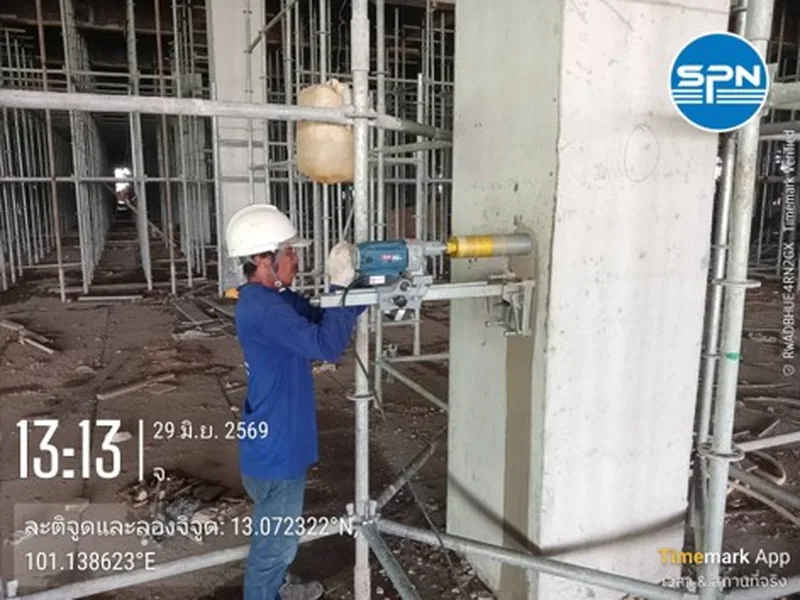
- Core Drilling and Compressive Strength (ASTM C42) — cylindrical concrete cores (core samples) are drilled from the actual structure and tested for compressive strength in the laboratory. This gives the most accurate values and is used to confirm concrete quality when it is suspected or disputed.
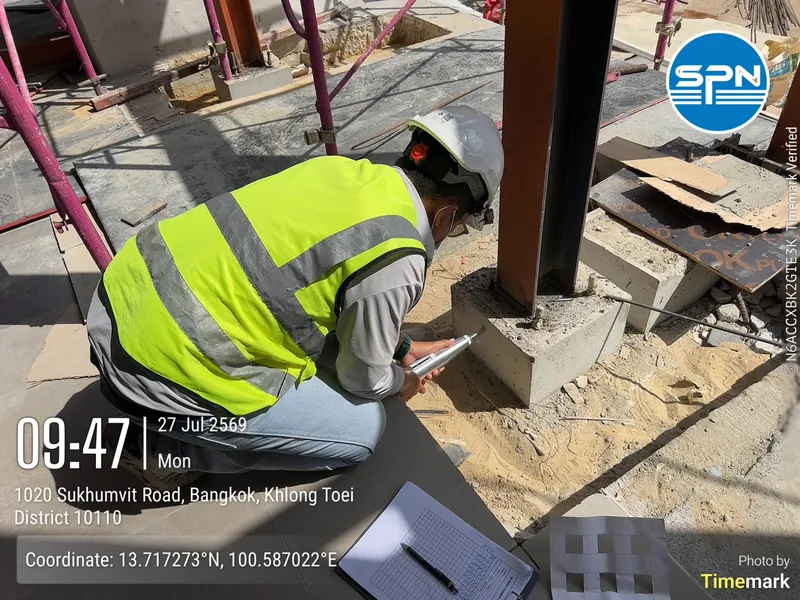
- Rebound Hammer Test / Schmidt Hammer (DPT 1502-51 · ASTM C805 · BS EN 12504-2) — tests concrete surface hardness with a spring hammer and converts the rebound number to an estimated compressive strength. Fast and non-destructive, suited to preliminary surveys of large areas.
- Ultrasonic Pulse Velocity (UPV) — ASTM C597 · DPT 1504-51 — high-frequency sound waves are sent through the concrete and their travel velocity is measured to assess quality and uniformity and to detect internal voids or cracks. Used together with Core Drilling for reliable results.
- Carbonation Depth Test (BS EN 14630) — phenolphthalein is sprayed on a fresh concrete section to measure the depth of carbonation (CO₂) penetration, used to assess remaining service life and the risk of rebar corrosion.
2. Detecting Cracks, Voids, Rebar and Buried Objects
Tests that use electromagnetic waves and advanced technology to detect anomalies inside structures and underground.
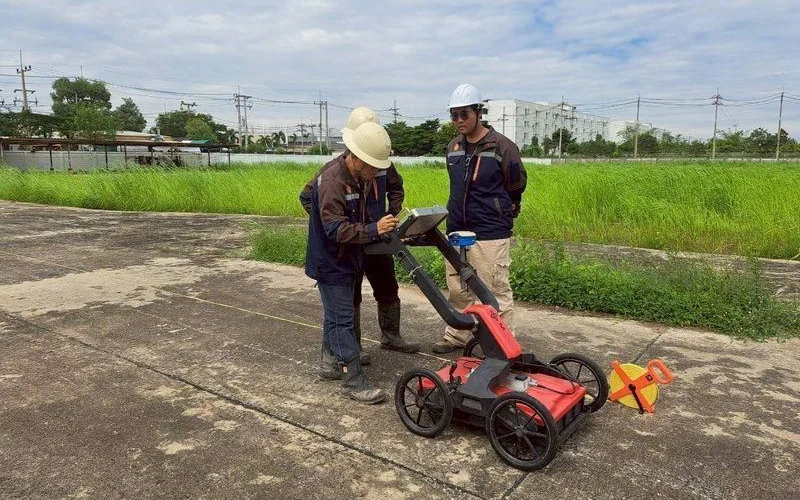
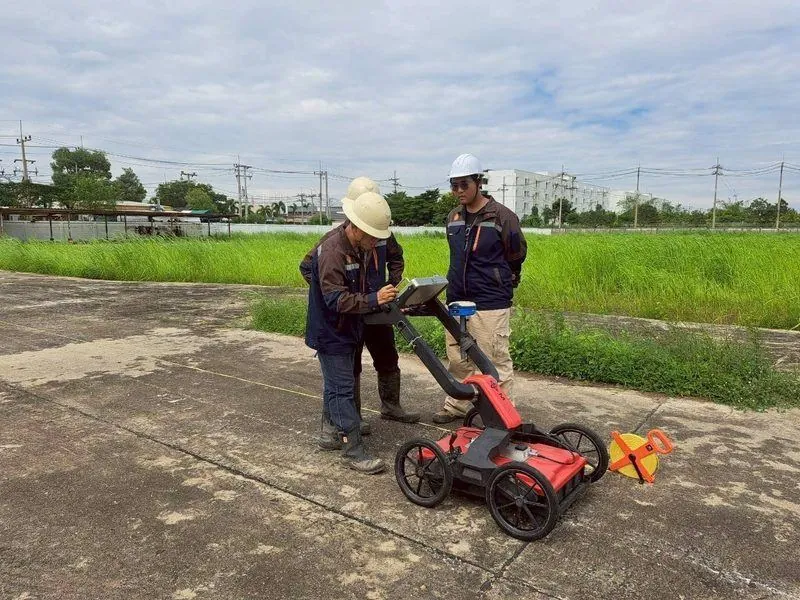
- Ground Penetrating Radar (GPR) — sends high-frequency electromagnetic waves through concrete or soil and analyzes the reflections as a radargram with GPS coordinates. There are 2 applications according to the reference documents: (1) Concrete structure scanning (DPT 1507-51 · ACI PRC-228.2) — locates rebar, concrete cover, voids and embedded pipes; detection depth depends on antenna frequency, concrete type and site conditions (high-frequency antennas give higher resolution but shallower depth), and (2) Subsurface survey (ASTM D6432) — locates underground pipes, buried objects, cavities and pavement layer thickness; depth depends on soil type, moisture and antenna frequency — in dry sand it may reach about 2–3 m or more, while in moist clay it is much shallower.
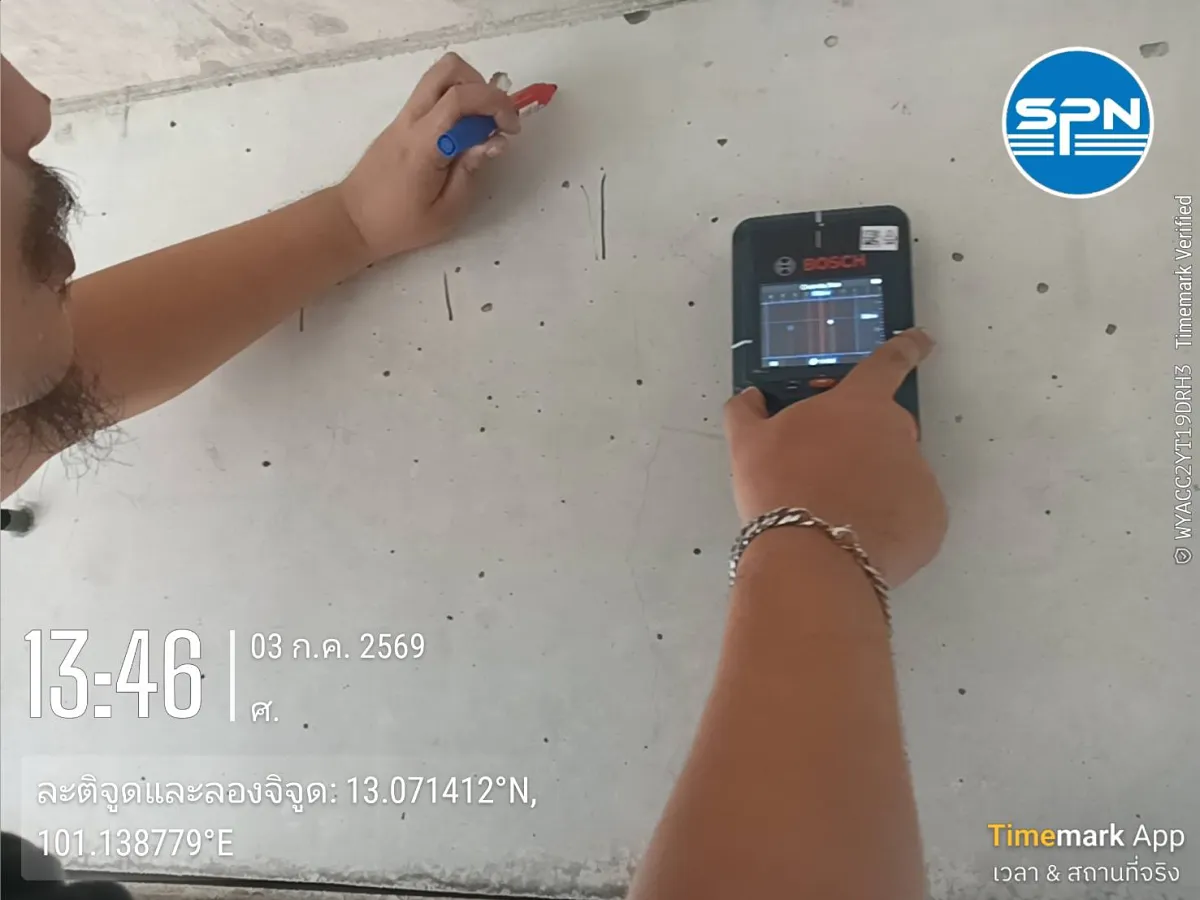
- Rebar Locator and Profometer (DPT 1505-51 · BS 1881-204) — identifies the position, size and cover depth of reinforcement in concrete without drilling. Suited to planning before Core Drilling and to checking bar placement against the drawings.
- Half-Cell Potential Test (ASTM C876 · DPT 1506-51) — measures the electrical potential of reinforcement through the concrete surface to assess corrosion probability. Suited to old structures or those in harsh environments.
- Crack Mapping and Monitoring — surveys and maps cracks (crack map) on concrete, brick and stone surfaces, measures width and length, and tracks changes with crack gauges to support cause analysis and repair planning.
3. Assessment of Existing Foundations and Piles
Tests to assess piles, existing foundations and the holding capacity of fixings in concrete.
- Pull Out Test — tests the tensile / pull-out strength of anchor bolts, threaded studs and fixings in concrete with a hydraulic jack and records the load-displacement curve, confirming holding capacity before real loads are applied. Suited to heavy equipment installation and steel structures.
- Parallel Seismic Test (ASTM D8381) — assesses the length of existing piles and foundations without demolishing the structure (a local excavation may be needed to strike the footing). A borehole is drilled beside the pile and vibration waves are measured with a hydrophone. Suited to old structures without construction drawings, repair work and building extensions.
- Side Echo Test (DPT 1551-51) — tests the integrity of piles or foundations whose heads cannot be reached. A pit is dug beside the footing, the side face is struck with a hand hammer and the signal is recorded with an accelerometer. Adapted from the Sonic Echo / Low-Strain Integrity method, it gives qualitative results and complements the Parallel Seismic Test; the two are not interchangeable for measuring pile length.
- Foundation and Structural Inspection (DPT 1501-51 · DPT 1902-62) — inspects footings, beams, columns and slabs, assessing damage, settlement, cracking and material deterioration, with an inspection report and maintenance recommendations.
4. Load Testing & Capacity Assessment
Work that confirms floors, bridges, roads and foundations can carry new service loads, by testing with real loads or by assessment from test results combined with calculation.
- Floor Loading Test (ACI 318 Chapter 27 · ACI 437.2) — tests the load-carrying capacity of a concrete floor slab by placing test loads and measuring deflection, confirming the floor carries its design load before use.
- Warehouse floor assessment for racks and forklifts — slab thickness and rebar positions are measured with GPR, or cores are taken to test concrete strength, then point loads from rack legs and forklift wheels are analyzed against the existing floor capacity. If the result is borderline, a Floor Load Test confirms it (how much load can a warehouse floor carry)
- Bridge and pier load test (AASHTO MBE · ACI 437.2) — tested with vehicles or known loads, measuring deflection with LVDTs / dial gauges and strain with strain gauges, as a Diagnostic Load Test (observing actual behavior to calibrate the model) or a Proof Load Test (directly proving the target load can be carried) (how a bridge load test is done)
- Road and concrete yard assessment for cranes / trailers — checks slab thickness and rebar, tests concrete strength, and tests the subgrade with a Plate Bearing Test, then analyzes crane wheel and outrigger loads against the capacity of the existing road or yard.
- Inspection of machine foundations, storage tank foundations and concrete columns — checks cracks, concrete strength, rebar positions and settlement of old machine foundations, settled or tilted tank foundations, and cracked concrete columns, assessing remaining capacity before deciding to keep using, repair or strengthen.
- Structural Back Analysis (DPT 1902-62) — back analysis from test and site inspection data to find the cause of damage, assess remaining load capacity and plan structural strengthening.
5. Damage & Condition Assessment
Work that records condition before and after an event and assesses whether a building can stay in use, needs repair, or needs strengthening.
- Adjacent building survey before construction (Dilapidation Survey) — records the condition of neighboring buildings before foundation work or excavation starts, with photos marked with location and date, a map of existing cracks (crack map), and crack gauges on significant cracks, to separate existing cracks from new ones if a dispute arises (what a Dilapidation Survey records)
- Vibration Monitoring (DIN 4150-3 · BS 7385-2) — measures peak particle velocity (PPV) at adjacent buildings during pile driving, excavation or machine operation, and compares it with the National Environment Board Notification No. 37 (B.E. 2553 (2010)) or DIN 4150-3 / BS 7385-2, as the project specifies (vibration monitoring during pile driving)
- Post-fire building assessment (DPT 1902-62 · ACI 562) — checks heat damage to concrete and rebar with a condition survey, Core Test, UPV and Rebound Hammer, classifies the damage level, then assesses whether members can be repaired or must be replaced (fire-damaged building: repair or demolish?)
- Post-earthquake building inspection (ATC-20 · DPT 1902-62) — a rapid inspection classifies safety (green, yellow, red placards), followed by a detailed inspection with testing where damage is found, to conclude whether the building can stay in use or needs repair and strengthening (post-earthquake building inspection)
- Structural inspection before buying or leasing (Technical Due Diligence) — inspects the structure, reviews documents and drawings, tests concrete and rebar at critical points, and assesses the existing foundation, summarizing the risks and required repairs before you decide (checklist before buying or leasing a building or warehouse)