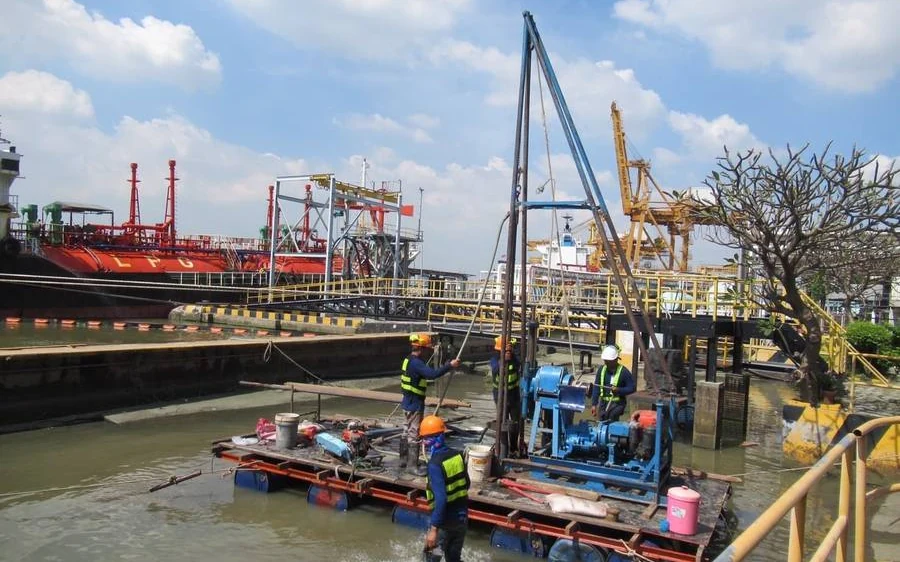
What is field in-situ soil testing?
Field in-situ testing measures and records soil properties directly at the project site. Many tests, such as CPT, Field Vane Shear and Plate Bearing, give readings immediately in the field without taking samples to a laboratory, so the parameters reflect real soil conditions at natural pressure and moisture. Others, such as SPT, test pits and rock/concrete coring, recover samples for further laboratory testing. The results are used to design foundations, piles, embankments and roads and for building-permit submissions to the relevant authorities. All tests are carried out to ASTM standards and certified by a licensed engineer.
Field soil tests we provide
SPN Soil Engineering provides complete field soil testing, grouped by purpose — tap to see the principle, standard and further reading for each test.
View all technical details
1. Tests for site investigation and foundation design
Tests used to determine soil properties for foundation and pile design and bearing capacity calculation, including:
- Standard Penetration Test (SPT) — ASTM D1586 The main test in soil boring. Soil samples are recovered with a split-spoon sampler driven by a standard 63.5 kg hammer with a 76 cm free fall, recording the N-Value every 1.5 m over the full depth. Used to estimate the relative density of sand and the undrained shear strength of clay, and to design pile length — read more: How to read SPT N-Values and How many boreholes, and how deep?
- CPT (Cone Penetration Test) — ASTM D3441 / D5778 A 10 cm² cone is pushed into the ground at a constant 2 cm/s, continuously measuring tip resistance (qc) and sleeve friction (fs), giving a more detailed soil profile than SPT. Suited to soft clay and silt.
- Field Vane Shear Test — ASTM D2573 A vane is rotated in soft clay to measure the undrained shear strength (Su) directly in the field. Suited to soils that are hard to sample, such as Bangkok soft clay and underwater sediments — read more: Field Vane Shear Test made simple
- Plate Bearing Test — ASTM D1195 / D1196 A 30-75 cm circular steel plate is loaded with a hydraulic jack and settlement is measured to find the Ultimate Bearing Capacity and Modulus of Subgrade Reaction (k) for raft foundation and slab-on-grade design — read more: What is a Plate Bearing Test? and When does the law require it?
2. Tests for roads, fill and compaction
Tests used for construction quality control and pavement design
- Field Density Test (Sand Cone) — ASTM D1556 A hole is dug in the fill and its volume is measured with standard sand; the dry density is compared with the Maximum Dry Density from the Standard or Modified Proctor test to check that the fill meets the specified % Compaction — read more: The complete Field Density Test guide
- DCP Test (Dynamic Cone Penetrometer) — ASTM D6951 A 20 mm cone is driven with an 8 kg hammer and the DCP Index is converted to CBR on the spot without excavating samples. Suited to checking subgrade and subbase quality at airports, roads and parking areas — read more: What is a DCP Test? and DCP vs KPT vs SPT compared
- Field CBR Test (In-Situ CBR) — following ASTM D4429-09a (withdrawn by ASTM in 2018) Tests the California Bearing Ratio directly in a test pit by pushing a standard solid steel piston and measuring the load-penetration curve, giving a more accurate CBR than DCP. Suited to pavement design for airports, main roads and parking areas that need high resolution.
- Light Penetrometer (Kunzelstab) — following DIN 4094 (former edition, now replaced by DIN EN ISO 22476-2) Soil density test by driving a steel rod of standard weight. Suited to large areas that need quick, low-cost results — read more: What is the Kunzelstab Penetration Test (KPT)? and DCP vs KPT vs SPT compared
3. Special investigation and sampling
- Test Pit Pits 1-5 m deep dug by backhoe or by hand to inspect soil layers visually, take undisturbed soil samples and check existing foundations. Suited to building repairs and investigation in confined areas — read more: House settlement and extensions: why test the soil first?
- Rock Coring (NMLC Triple Tube) — ASTM D2113 Rock cores are recovered with a diamond bit and the Rock Quality Designation (RQD) is calculated to assess rock mass quality. Suited to large projects on rock, such as dams, tunnels and power plants.
- Concrete Coring — ASTM C42 Concrete cores are drilled from existing structures to test compressive strength, check concrete quality and open inspection windows into the soil beneath existing structures. Suited to building inspection and repair work.
- Observation / Monitoring Well PVC pipe installed in a borehole to measure and monitor groundwater level over the long term. Used in EIA work, environmental monitoring and projects that must control groundwater level.
- Downhole Seismic Test — ASTM D7400 Measures shear-wave velocity (Vs) and compression-wave velocity (Vp) in each soil layer, with a source at the ground surface and geophones in the borehole. Used to calculate Shear Modulus (G₀) and Poisson's Ratio and to classify the Site Class per ASCE 7 / IBC for the seismic design of petrochemical plants, power plants and important buildings — read more: Earthquakes, foundations and liquefaction
- Electrical Soil Resistivity Test — ASTM G57 Measures soil electrical resistivity (apparent resistivity, Ω·m) by the Four-Point Wenner Array method. Results are used to design grounding systems and assess the corrosion risk of buried metal pipes (Cathodic Protection).
- Soil Thermal Conductivity Test — ASTM D5334 (IEEE 442) Tests soil thermal conductivity (λ) and thermal resistivity in the field by the Thermal Needle Probe method. Results are used to design geothermal heat exchangers and set derating factors for underground power cables to prevent heat build-up in the soil. Read the test procedure and real results from a 115 kV transmission line project in Soil Thermal Resistivity Test and Ambient Temperature Test
- In-Situ Permeability Test (borehole permeability) — ISO 22282-2 / ISO 22282-3 Water is added to or pumped from the casing and the rate of water-level change is measured (Falling / Rising Head), or water is injected in stages with a packer in rock (Lugeon Test), giving the permeability coefficient (k) of the actual soil mass in the field. Used for the design of dewatering systems, deep excavations, embankments and dams.
Field soil test summary table
← Scroll to see the full table →
Field soil test summary table with standards, results and applications
| Test | Standard | Result | Used for |
|---|
| SPT Standard Penetration Test | ASTM D1586 | N-Value | Foundation & pile design |
| CPT Cone Penetration Test | ASTM D3441 / D5778 | qc, fs, Rf | Continuous soil profile |
| Field Vane Shear Test | ASTM D2573 | Su (kPa) | Soft clay shear strength |
| Plate Bearing Test | ASTM D1195 / D1196 | qu, k (MN/m³) | Raft / slab-on-grade design |
| Field Density Test (Sand Cone) | ASTM D1556 | % Compaction | Fill quality control |
| DCP Test | ASTM D6951 | CBR (%) | Pavement subgrade design |
| Light Penetrometer (Kunzelstab) | Following DIN 4094 (replaced by DIN EN ISO 22476-2) | N (blows/20 cm) | Quick density check |
| Test Pit | In-situ | Soil layers / samples | Soil & existing foundation survey |
| Rock Coring (NMLC) | ASTM D2113 | RQD (%) | Rock mass quality assessment |
| Concrete Coring | ASTM C42 | Compressive Strength (ksc) | Concrete quality of existing structures |
| Observation Well | In-situ | GWL (m) | Groundwater level monitoring |
| Downhole Seismic Test | ASTM D7400 | Vs, Vp (m/s) | Site Class / Shear Modulus G₀ |
| Electrical Soil Resistivity | ASTM G57 | ρ (Ω·m) | Grounding / cathodic protection design |
| Field CBR Test (In-Situ CBR) | Following ASTM D4429-09a (withdrawn by ASTM in 2018) | CBR (%) | Pavement design for airports, main roads |
| Soil Thermal Conductivity Test | ASTM D5334 | λ (W/m·K) | Geothermal design / cable derating |
| In-Situ Permeability (Falling / Rising Head, Lugeon) | ISO 22282-2 / 22282-3 | k (m/s), Lugeon | Dewatering, excavations, embankments, dams |
SPT vs CPT: what is the difference, and which should you choose?
SPT and CPT are the two most widely used methods in soil investigation. SPT works in almost all soil types, including dense sand and hard soil (in coarse gravel the N-value may be overstated; rock is investigated by rock coring), recovers soil samples at the same time and costs less, but its results depend more on operator skill. CPT gives more continuous and consistent data with higher accuracy in clay and sand, but cannot penetrate gravel or rock. In practice the two are often used together, with SPT as the main method and CPT added where detailed data is needed.
Choosing the right tests for your project
Each type of project needs different soil data. Choosing the right tests reduces cost and delivers the parameters engineers need for design. SPN recommends test sets for 6 project groups: houses, high-rises and factories, roads and runways, dams and over-water work, projects on rock, and environmental and groundwater work.
Houses and small buildings
SPT + Field Vane Shear
Foundation design, economical
High-rises & factories
Multiple SPT holes + CPT + Plate Bearing
Foundation & pile design
Roads, runways and fill
Field Density Test + DCP Test
Compaction quality control of every layer
Dams, embankments and over-water work
SPT on floating raft + Vane Shear + Test Pit
Survey of soil layers below water
Projects on rock
Rock Coring + RQD Analysis
Foundation quality on rock for dams, tunnels, power plants
Environmental & groundwater work
Observation Well + Monitoring
Long-term groundwater level monitoring